TorontoOntario · 36 tours
 Niagara FallsOntario · 25 tours
 New York CityNew York · 30 tours
 Las VegasNevada · 8 tours
 San FranciscoCalifornia · 16 tours
 VancouverBritish Columbia · 17 tours
 DubaiUAE · 54 tours
 Abu DhabiUAE · 5 tours
 Buenos AiresArgentina · 23 tours
 AthensGreece · 31 tours
 AucklandNew Zealand · 38 tours
 CancunMexico · 54 tours
No destinations match “”. Try searching all tours instead — that search understands full questions, not just place names.
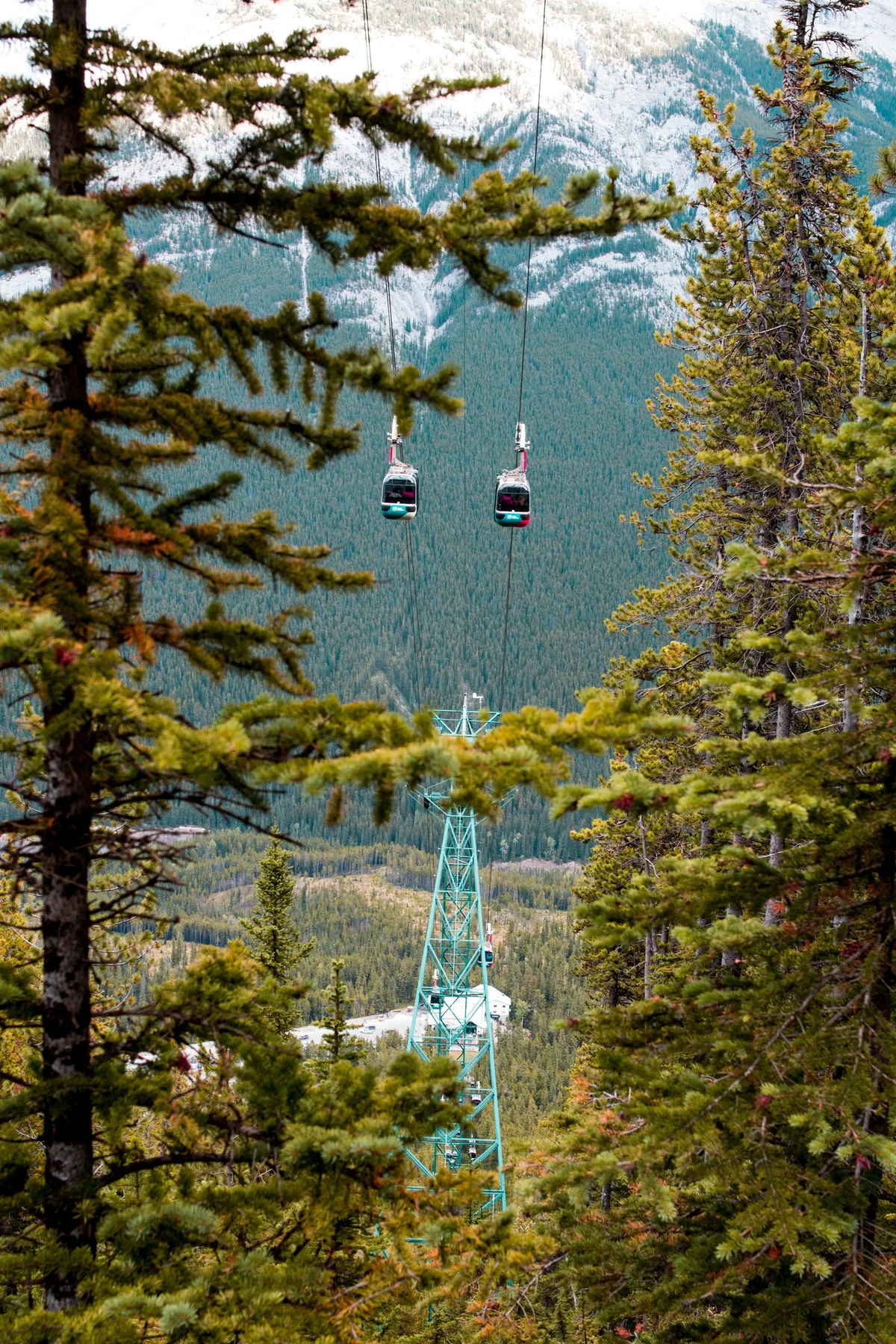
A cable car climbing Sulphur Mountain from the edge of Banff townsite, with a boardwalk and panoramic views of the Bow Valley at the top.
Visitor guide
The Banff Gondola carries passengers up the eastern flank of Sulphur Mountain to an upper terminal at about 2,281 m (7,486 ft), climbing roughly 698 m (2,292 ft) from a base station at 1,583 m in around eight minutes. From the summit complex, a boardwalk leads on to Sanson's Peak, with views over Banff townsite and the Bow Valley.
Sulphur Mountain takes its name from the hot springs on its lower slopes; it was named in 1916, and the geologist George Dawson had earlier labelled it Terrace Mountain on an 1886 map. Its Stoney name is recorded as Mini Rhuwin. A meteorological observatory was completed on Sanson's Peak in 1903, tended by Norman Bethune Sanson, a Banff Park Museum curator who climbed up regularly to check the weather instruments. The operator says he made the trip weekly for about 30 years until 1945, when he was 84, and other accounts say more than 1,000 ascents. The peak was named for him in 1948.
The original lift was built between September 1958 and July 1959 by Bell Engineering Works of Switzerland and opened in 1959. It was reconstructed from November 1997 to February 1998 by Garaventa AG, also of Switzerland. Today it is run by the Banff Jasper Collection. Other claims circulate about a 1940s teahouse on the mountain and about the cost of later renovations; we could not confirm them from primary sources, so they are not repeated here.
In 1956-57 the National Research Council built a laboratory on Sanson's Peak to study cosmic rays for the International Geophysical Year. The Sulphur Mountain Cosmic Ray Station operated until 1978 and is recognised as a National Historic Site of Canada; Wikipedia says the building was removed in 1981 and the spot is marked by a plaque, so the station is best thought of as a historic site rather than a building to tour. The meteorological observatory from 1903 is still standing.
At the top, the operator describes a self-guided interpretive centre about Banff's stories and Sulphur Mountain's natural history, and a self-guided boardwalk that runs to Sanson's Peak. The operator says Sanson's Peak is about 10 m above the upper terminal, and Wikipedia gives the true summit of Sulphur Mountain as 2,451 m, so the gondola top is not the highest point on the mountain; more experienced hikers can continue by a ridge trail to the true summit. The operator says the summit complex is reachable by elevator and the cabins take most wheelchairs, but the boardwalk to Sanson's Peak has 368 shallow stairs each way and is not wheelchair accessible. Sulphur Mountain's hot springs are also home to the endangered Banff Springs snail.
The mountain can also be climbed on foot by the switchback trail beneath the gondola, listed at around 5.4 km, with the older Sanson Road route around 5.8 km. Both gain substantial elevation.
See every tour and attraction we cover in Banff.