TorontoOntario · 36 tours
 Niagara FallsOntario · 25 tours
 New York CityNew York · 30 tours
 Las VegasNevada · 8 tours
 San FranciscoCalifornia · 16 tours
 VancouverBritish Columbia · 17 tours
 DubaiUAE · 54 tours
 Abu DhabiUAE · 5 tours
 Buenos AiresArgentina · 23 tours
 AthensGreece · 31 tours
 AucklandNew Zealand · 38 tours
 CancunMexico · 54 tours
No destinations match “”. Try searching all tours instead — that search understands full questions, not just place names.
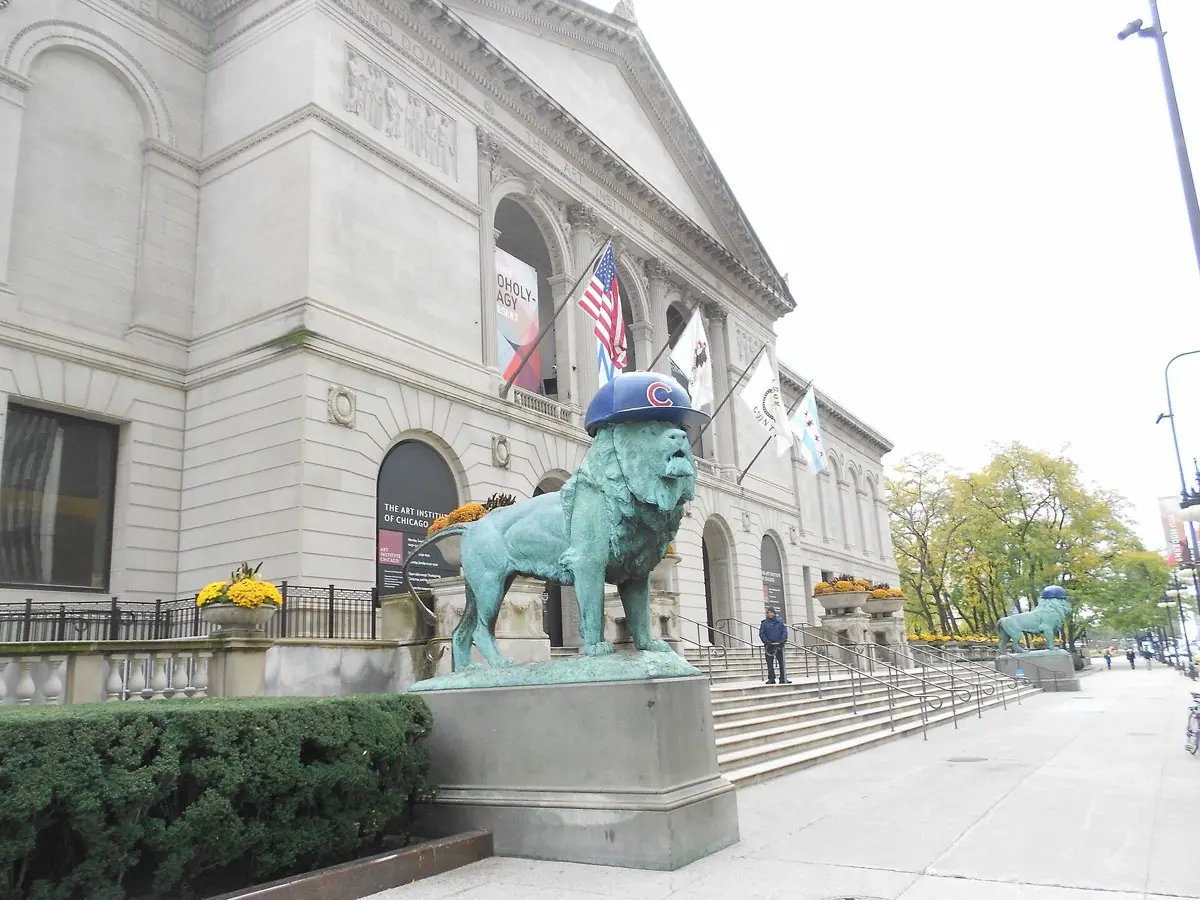
One of the largest and most respected art museums in the US, guarded by its iconic bronze lions.
Visitor guide
The Art Institute of Chicago is a major art museum and school on Michigan Avenue in Grant Park, with a permanent collection of nearly 300,000 works. Its Beaux-Arts home dates to the 1893 World's Columbian Exposition, and it is guarded by Edward Kemeys's famous bronze lions.
The museum's roots lie in the Chicago Academy of Design, founded in 1866 by 35 artists and chartered the following year. Its building was destroyed in the Great Chicago Fire of 1871. In 1879 former members founded the Chicago Academy of Fine Arts, which took its present name, the Art Institute of Chicago, in 1882. Charles L. Hutchinson served as its first president until his death in 1924. The institution bought land at Michigan Avenue and Van Buren Street in 1882, and a building designed by John Wellborn Root opened there in 1887.
The present core building was designed by Shepley, Rutan and Coolidge of Boston in the Beaux-Arts style. It was built as the World's Congress Auxiliary Building for the 1893 exposition, and the Art Institute took possession on November 1, 1893, with the building opening to the public on December 8 that year. Over the following century it grew through additions such as the Ryerson Library (1901), McKinlock Court (1924), and the Rice Building (1988). The east entrance preserves a stone arch from Louis Sullivan's Chicago Stock Exchange, and a salvaged Stock Exchange trading room is displayed inside.
The two bronze lions by Edward Kemeys were unveiled on May 10, 1894. Each weighs more than two tons and was cast in Chicago by the American Bronze Founding Company, according to the museum. Their poses differ: the north lion is described as on the prowl, and the south lion as in an attitude of defiance. Accounts differ on who commissioned them, with one museum article crediting Mrs. Henry Field and the collection records listing the Art Institute and Florence Lathrop Field. Fans routinely dress the lions in team jerseys when Chicago teams reach the playoffs.
Renzo Piano designed the Modern Wing, which opened on May 16, 2009. At 264,000 square feet it rivals the original 1893 building in scale, and it houses the museum's 20th- and 21st-century art, architecture, design and photography. A 620-foot pedestrian link, the Nichols Bridgeway, also designed by Piano, connects the museum to Millennium Park. Wikipedia notes the wing helped make the Art Institute the second-largest art museum in the United States after the Metropolitan Museum of Art; treat that ranking as an approximate claim.
The collection spans eleven curatorial departments. Frequently cited highlights include Georges Seurat's A Sunday Afternoon on the Island of La Grande Jatte, Pablo Picasso's The Old Guitarist, Edward Hopper's Nighthawks, which the museum bought in 1942, and Grant Wood's American Gothic, which was acquired after winning a medal in a competition at the institute. The Thorne Miniature Rooms, 68 interiors built at 1:12 scale, show European and American rooms from the Middle Ages to the 1930s. The photography holdings number roughly 20,000 works. Outdoors, the North McCormick Courtyard contains Alexander Calder's Flying Dragon.
The School of the Art Institute of Chicago is legally part of the museum, and the Ryerson and Burnham Libraries on the ground floor form a major art and architecture research resource; the Burnham Library was founded in 1912. Works are rotated and galleries change, so check the museum for what is on view, including whether a specific lion or painting is currently displayed.
The museum sits beside Millennium Park and the rest of Grant Park, so it pairs naturally with a lakefront day. On a private tour with Voyzo, your driver can drop you at the Michigan Avenue side and meet you afterward, which makes it easy to spend as long as you like inside. Check the museum for current hours, tickets and gallery closures.
See every tour and attraction we cover in Chicago.