TorontoOntario · 36 tours
 Niagara FallsOntario · 25 tours
 New York CityNew York · 30 tours
 Las VegasNevada · 8 tours
 San FranciscoCalifornia · 16 tours
 VancouverBritish Columbia · 17 tours
 DubaiUAE · 54 tours
 Abu DhabiUAE · 5 tours
 Buenos AiresArgentina · 23 tours
 AthensGreece · 31 tours
 AucklandNew Zealand · 38 tours
 CancunMexico · 54 tours
No destinations match “”. Try searching all tours instead — that search understands full questions, not just place names.
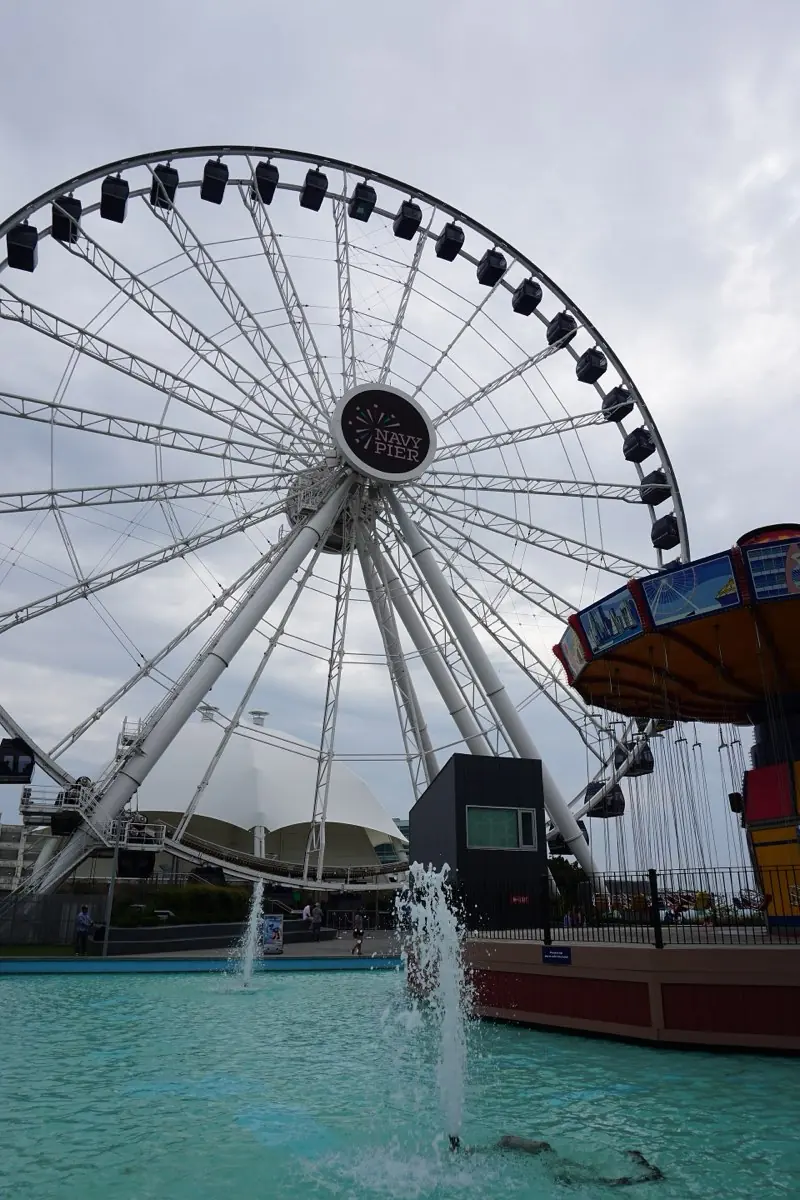
A century-old pier turned entertainment district, with a Ferris wheel and lake views.
Visitor guide
Navy Pier is a long pier on Lake Michigan in Chicago's Streeterville neighborhood. It opened in 1916 as Municipal Pier, served as a naval training site and a university campus, and was redeveloped in the 1990s into the lakefront entertainment and cultural destination known today.
Navy Pier opened to the public as Municipal Pier on July 15, 1916. Architect Charles Sumner Frost designed it based on Daniel Burnham's 1909 Plan of Chicago, and it was built for shipping and recreation. It is about 3,300 feet long, according to Wikipedia, and was built on about 20,000 logs imported from Oregon and driven into the lake bed. The pier was renamed Navy Pier in 1927 to honor Navy personnel stationed there during World War I. In 1921 it hosted the Pageant of Progress, which drew over one million visitors across fifteen days. The opening of the St. Lawrence Seaway in 1959 briefly boosted commercial shipping.
During World War II the pier became a Navy training center from 1941, with about 10,000 people working, training and living there. Wikipedia lists a 2,500-seat theater, a gym, a barber shop, a tailor, a cobbler, a soda fountain, a kitchen and a hospital among its facilities. Two training carriers, the USS Wolverine and USS Sable, helped qualify about 18,000 naval aviators. From 1946 to 1965 the pier housed the Chicago campus of the University of Illinois, according to the Chicago Landmarks record, serving returning veterans, and the school's growth led to the later University of Illinois at Chicago. Chicago designated it a Chicago Landmark in 1977.
After commercial shipping declined, the city explored new uses; the East End buildings were renovated in 1976 and ChicagoFest was held there. A study by the Urban Land Institute was commissioned in 1989, and the Metropolitan Pier and Exposition Authority was created to oversee redevelopment. The original sheds were torn down in 1992 to make way for new recreational and convention space, while the masonry structures at either end of the pier were kept. The redeveloped pier reopened in July 1995. In 2011 Navy Pier became a nonprofit organization, and its Centennial Vision plan, with a design by James Corner Field Operations selected in 2012, led to improvements for the 100th anniversary in 2016, including the Centennial Wheel, Polk Bros Park and the Peoples Energy Welcome Pavilion. The Polk Family Foundation donated $20 million toward the park, and the redesigned pier earned Gold certification under the Sustainable SITES Initiative in November 2016.
The Centennial Wheel is a 196-foot Ferris wheel that opened in May 2016; it replaced an earlier wheel that was sold in 2015 and moved to Branson, Missouri. Wikipedia describes it as a 42-gondola Dutch Wheels model built to withstand 115 mph winds, and the first of its kind in the United States. Crystal Gardens is a one-acre botanical garden in a six-story glass atrium. The pier is also home to the Chicago Children's Museum and the Chicago Shakespeare Theater, plus outdoor rides in Pier Park, a carousel and a lakefront promenade. Festival Halls A and B can be combined into an arena of about 170,000 square feet. Public art includes a Bob Newhart statue with a couch, an anchor from the USS Chicago, and J. Seward Johnson Jr.'s Crack the Whip. Wikipedia reports more than nine million visitors a year, though counts vary by source.
The halls stood in for Atlantic City in the 1986 film The Color of Money, and car chases were filmed here for Raw Deal and Cooley High. Wikipedia also notes that Wheel of Fortune taped episodes on the pier in 2002 and 2008.
Attractions, events, fireworks nights and opening times vary through the year, so check Navy Pier's official site for the current schedule. On a private Voyzo tour, your driver can pick you up at your hotel and drop you at the pier, then collect you when you are ready to move on, so it fits easily into a day of lakefront and downtown sightseeing.
See every tour and attraction we cover in Chicago.