TorontoOntario · 36 tours
 Niagara FallsOntario · 25 tours
 New York CityNew York · 30 tours
 Las VegasNevada · 8 tours
 San FranciscoCalifornia · 16 tours
 VancouverBritish Columbia · 17 tours
 DubaiUAE · 54 tours
 Abu DhabiUAE · 5 tours
 Buenos AiresArgentina · 23 tours
 AthensGreece · 31 tours
 AucklandNew Zealand · 38 tours
 CancunMexico · 54 tours
No destinations match “”. Try searching all tours instead — that search understands full questions, not just place names.
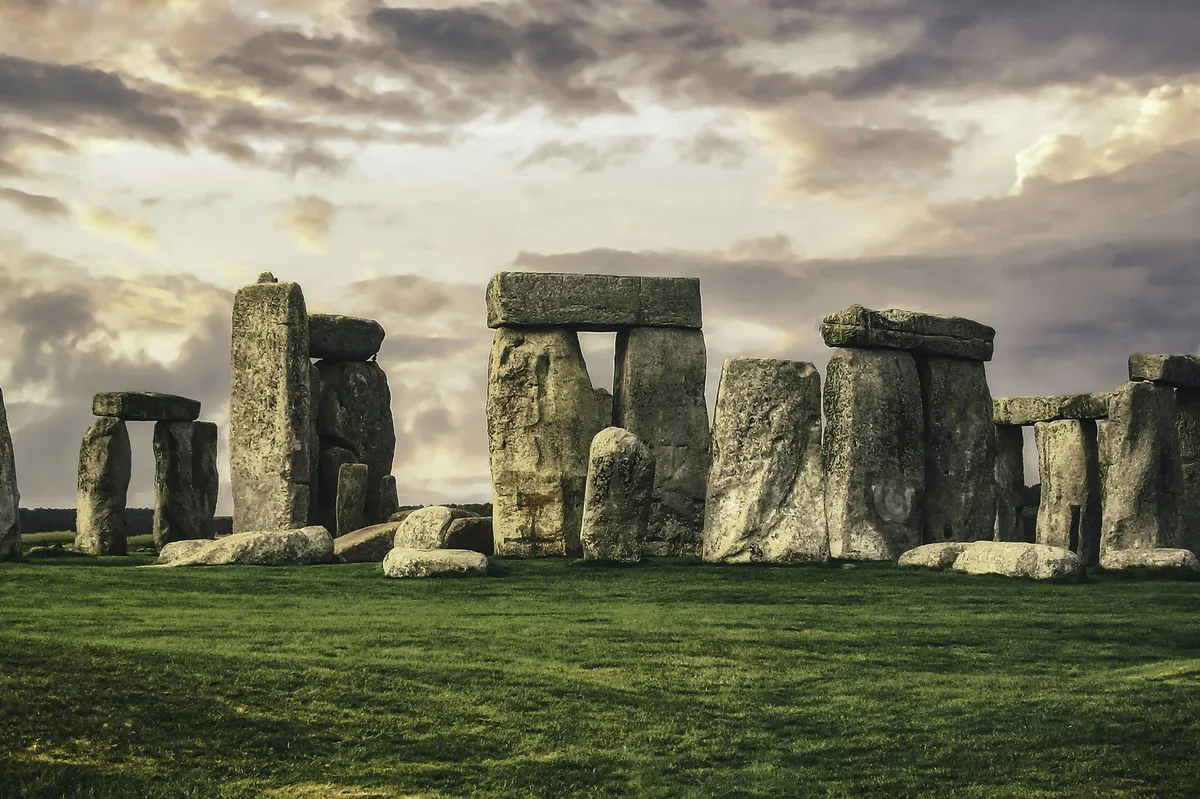
The prehistoric stone circle on Salisbury Plain, one of the world's most famous archaeological sites and a UNESCO World Heritage Site dating back around 5,000 years.
Visitor guide
Stonehenge is a prehistoric stone monument on Salisbury Plain in Wiltshire, England, about three kilometres west of Amesbury. A ring of large standing stones topped with lintels encloses smaller stones and free-standing trilithons, and the monument is part of the UNESCO World Heritage Site Stonehenge, Avebury and Associated Sites.
Wikipedia describes construction in several phases between about 3100 BC and 1600 BC, though dating is complex. The first phase was a circular bank and ditch about 110 metres across with 56 pits known as the Aubrey holes. Around 2900 to 2600 BC timber structures were added and the site served as a cremation cemetery. The main stone arrangement began from about 2600 BC, with a circle of around 30 sarsen stones capped with lintels held by mortise-and-tenon and tongue-and-groove joints, and five trilithons set in a horseshoe.
Smaller bluestones were set up and later rearranged into a circle and a horseshoe. The Z and Y holes, the last known construction, date to about 1600 BC.
A 2020 study led by David Nash found a chemical match between the sarsens and stone at West Woods, about 26 kilometres to the north. The bluestones are generally linked to the Preseli Hills in Pembrokeshire, roughly 230 kilometres away, and some researchers have proposed they were first part of a circle at Waun Mawn, a proposal that remains debated. A 2024 study suggested that the Altar Stone may come from northern Scotland rather than Wales, a finding best treated as recent and provisional.
No direct evidence survives of how the stones were moved. Experiments have shown that sledges and log tracks can work, including a 1995 trial moving a 40-ton slab about 29 kilometres.
Nobody knows for certain. The monument is aligned with the summer solstice sunrise and the winter solstice sunset. Gerald Hawkins proposed in the 1960s that it tracked the sun and moon, while Geoffrey Wainwright and Timothy Darvill suggested a place of healing. Mike Parker Pearson has argued that Stonehenge was a domain of the dead linked by the River Avon to Durrington Walls, a settlement of the living with its own timber circle.
Cremated remains from at least 63 individuals have been analysed. They included men, women and children, and a 2018 strontium study suggested many individuals buried around the time of construction came from near the Welsh bluestone source.
The stone circle has been a scheduled monument since the Ancient Monuments Protection Act 1882 and became a World Heritage Site in 1986. The monument was given to the nation in 1918 and is cared for by English Heritage, while surrounding land belongs to the National Trust. Stone 22 fell in a storm on 31 December 1900, and restoration work took place in 1901, 1920, 1958 and 1963. Recent surveys, including the Stonehenge Hidden Landscape Project, have revealed further monuments in the surrounding landscape.
A private guided visit works well here, as the surrounding landscape with its burial mounds and the Avenue is part of the story, and a guide can place the monument in the context of nearby sites such as Avebury and Salisbury.
See every tour and attraction we cover in United Kingdom.