TorontoOntario · 36 tours
 Niagara FallsOntario · 25 tours
 New York CityNew York · 30 tours
 Las VegasNevada · 8 tours
 San FranciscoCalifornia · 16 tours
 VancouverBritish Columbia · 17 tours
 DubaiUAE · 54 tours
 Abu DhabiUAE · 5 tours
 Buenos AiresArgentina · 23 tours
 AthensGreece · 31 tours
 AucklandNew Zealand · 38 tours
 CancunMexico · 54 tours
No destinations match “”. Try searching all tours instead — that search understands full questions, not just place names.
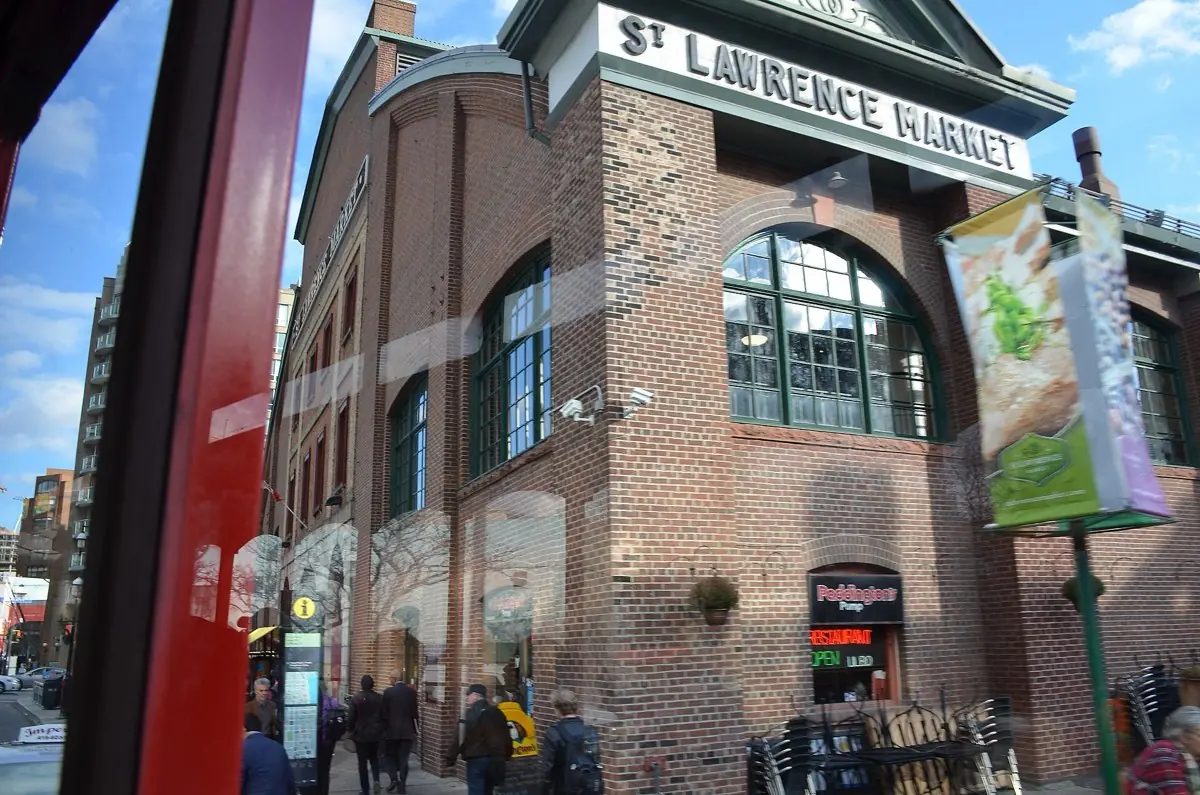
One of the world's great food markets, housed in a historic 19th-century building.
Visitor guide
St. Lawrence Market is Toronto's historic public food market, a pair of buildings on Front Street East whose roots go back to the very beginning of the town of York. It is best known today for its South Market, a hall of independent food merchants, and for the peameal bacon sandwich that locals and visitors alike line up for. National Geographic named it the world's best food market in 2012, a ranking that has followed it ever since.
The market's story starts in 1803, when Lieutenant Governor Peter Hunter set aside a site and a weekly market day for the young town. The first market square sat near King and New Streets. A temporary shelter went up in 1814 and a first permanent structure in 1820; the town's first public well was dug on the property in 1823. A brick market building followed in 1831, and its upper rooms housed city council until the mid-1840s.
The Great Fire of 1849 damaged the northern side of the market block, and that section was cleared and rebuilt. St. Lawrence Hall, a Victorian civic and concert building, rose just north of the market, and a new market arcade was added. The South Market building has older bones than it looks: part of it dates to the 1840s, when the structure served as Toronto's City Hall; the Ontario Heritage Trust dates that Market House and City Hall to 1844. When the city government moved to what is now called Old City Hall in 1899, the former council space was absorbed into a new market building. According to the Ontario Heritage Trust, the City rebuilt the north and south market buildings in 1899, and the present-day South Market was designed by John W. Siddall and completed in 1904.
The North Market has had several lives. A north wing was added in the early 1900s, replaced in 1968 by a single-storey building, which was in turn demolished in 2015 for a larger replacement. According to Wikipedia, the new North Market building's courthouse opened in March 2025 and the Farmers' Market returned to the site in April 2025; check the market's own channels for how the buildings are operating today.
The South Market is the part most visitors picture: an enclosed hall of independent merchants selling fish, meat, cheese, produce, baked goods, prepared foods, and pantry staples. Upstairs, the Market Gallery occupies the former council chamber from the days when the building was Toronto's City Hall, a quiet reminder of the building's civic past.
The North Market has traditionally hosted the Saturday Farmers' Market, where farmers sell directly to shoppers, and a Sunday antiques market. The official site currently lists antique and vintage events as scheduled dates rather than a standing weekly market, so confirm what is on before you plan around it.
Peameal bacon is unsmoked back bacon made from trimmed, boneless pork loin that is cured in a brine and rolled in cornmeal. The name is a leftover from an older practice of coating the cured meat in ground dried yellow peas to help it keep; cornmeal replaced the peas after the First World War. Toronto pork packer William Davies is generally credited with popularizing it, though the exact origin is uncertain. Served on a soft bun, it became a Toronto signature, and the St. Lawrence Market version is the best known. According to Wikipedia, in the 1960s a butcher and a baker at the market began selling the bacon ends on buns, and that stall evolved into the Carousel Bakery.
The market sits at the edge of the St. Lawrence neighbourhood and the Old Town of York, so the Flatiron Building, the Distillery District, St. James Cathedral, and the Hockey Hall of Fame are all close. On a private Voyzo tour, your driver can drop you at the door and collect you when you are done, which is helpful if you plan to buy anything perishable or heavy.
See every tour and attraction we cover in Toronto.