TorontoOntario · 36 tours
 Niagara FallsOntario · 25 tours
 New York CityNew York · 30 tours
 Las VegasNevada · 8 tours
 San FranciscoCalifornia · 16 tours
 VancouverBritish Columbia · 17 tours
 DubaiUAE · 54 tours
 Abu DhabiUAE · 5 tours
 Buenos AiresArgentina · 23 tours
 AthensGreece · 31 tours
 AucklandNew Zealand · 38 tours
 CancunMexico · 54 tours
No destinations match “”. Try searching all tours instead — that search understands full questions, not just place names.
Toronto's modernist City Hall and its public square, home to the iconic 'TORONTO' sign.
Visitor guide
Toronto City Hall and Nathan Phillips Square sit at Queen Street West and Bay Street, opposite Old City Hall. The building, designed by Finnish architect Viljo Revell, is among the best-known examples of mid-century modernist civic architecture in Canada. In front of it, the 4.85-hectare square serves as the city's main public gathering space.
In the late 1950s the city ran an international design competition for a new city hall. Wikipedia reports 731 entries registered and about 540 valid submissions from 42 countries by the April 1958 deadline, while the City of Toronto's own exhibit cites 520 entries from 42 countries; the exact count varies by source. Revell's design was announced on September 26, 1958. He worked with local architects John B. Parkin Associates and structural engineer Hannskarl Bandel.
The sod was turned on November 7, 1961, and Governor General Georges Vanier officially opened the building on September 13, 1965. Revell died in late 1964 (the City of Toronto's exhibit gives November), before the building was finished, and so never saw it completed. The square is named for Mayor Nathan Phillips, who held office from 1955 to 1962. Before construction, the site had been part of The Ward, an immigrant district that included Toronto's first Chinatown, and its businesses were expropriated.
The design has two curved office towers of unequal height, 27 and 20 storeys, that curve around a domed, saucer-shaped council chamber. Sources give the heights as roughly 99.5 to 99.7 metres for the taller tower and 79.4 to 79.6 metres for the shorter one. The chamber is on the second floor, supported by a single concrete column. The City designated the building under the Ontario Heritage Act in 1991, and it received the Ontario Association of Architects' 25-Year Award in 1998.
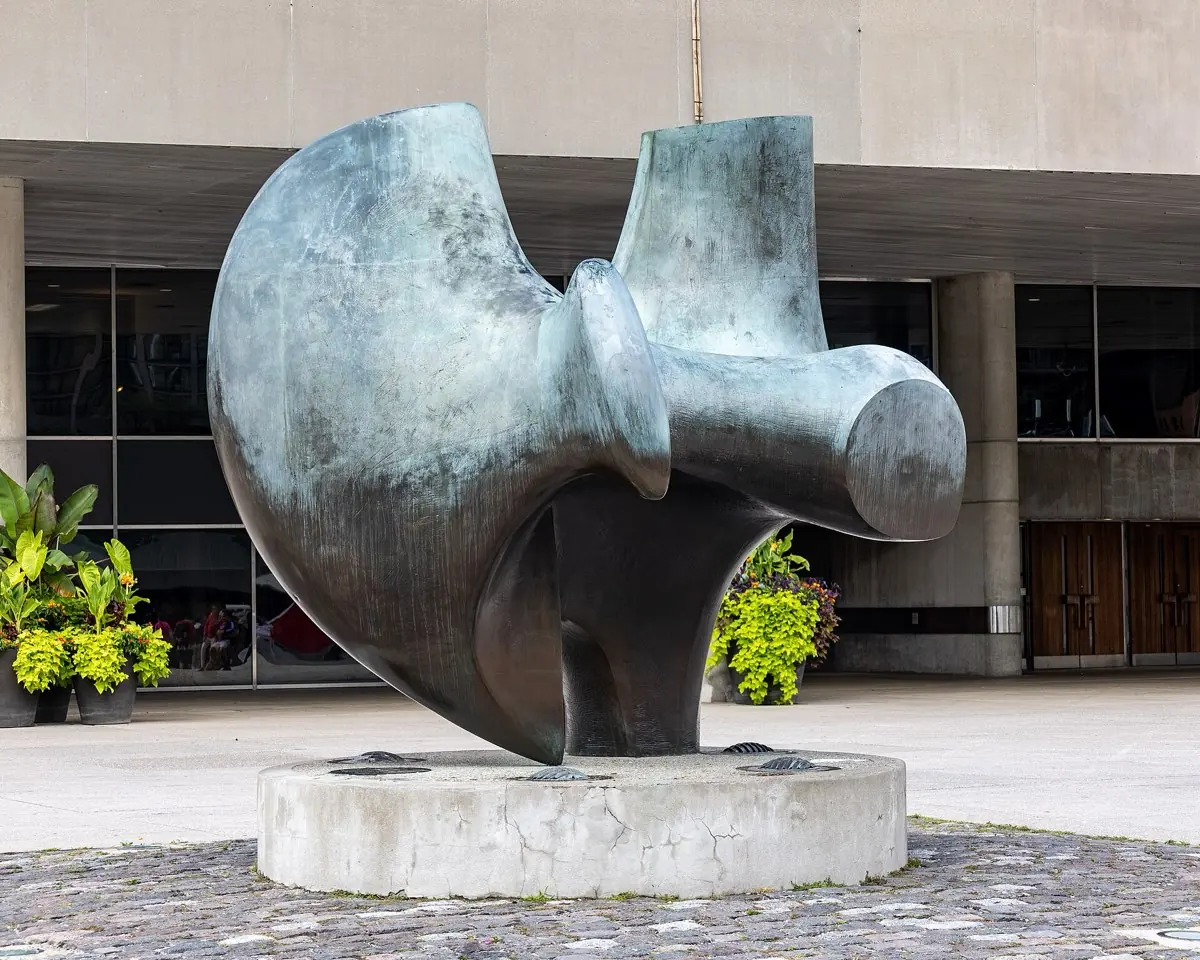
The square's reflecting pool becomes a skating rink in winter, first used for that purpose in November 1964. Three concrete arches span the pool; they were dedicated as the Freedom Arches in 1989, and a piece of the Berlin Wall stands at the base of the central arch. The Peace Garden commemorates the Hiroshima bombing, and Henry Moore's sculpture Three-Way Piece No. 2 (The Archer) was unveiled on October 27, 1966, after a debated purchase funded in part by public subscription. The Spirit Garden, created as part of reconciliation efforts, lists residential schools in Ontario.
The three-dimensional TORONTO sign was installed in 2015 for the Pan Am and Parapan Am Games and was then made permanent. It is among the most photographed spots in the city. The square also hosts festivals, markets, and civic events, and Wikipedia notes that it was the site of the 2019 Toronto Raptors victory parade.
Old City Hall, the Eaton Centre, the Art Gallery of Ontario, Osgoode Hall, and Chinatown are all within walking distance. A private Voyzo tour can include a short photo stop here between downtown sights, with your driver nearby, as street parking in this area is limited.
See every tour and attraction we cover in Toronto.