TorontoOntario · 36 tours
 Niagara FallsOntario · 25 tours
 New York CityNew York · 30 tours
 Las VegasNevada · 8 tours
 San FranciscoCalifornia · 16 tours
 VancouverBritish Columbia · 17 tours
 DubaiUAE · 54 tours
 Abu DhabiUAE · 5 tours
 Buenos AiresArgentina · 23 tours
 AthensGreece · 31 tours
 AucklandNew Zealand · 38 tours
 CancunMexico · 54 tours
No destinations match “”. Try searching all tours instead — that search understands full questions, not just place names.
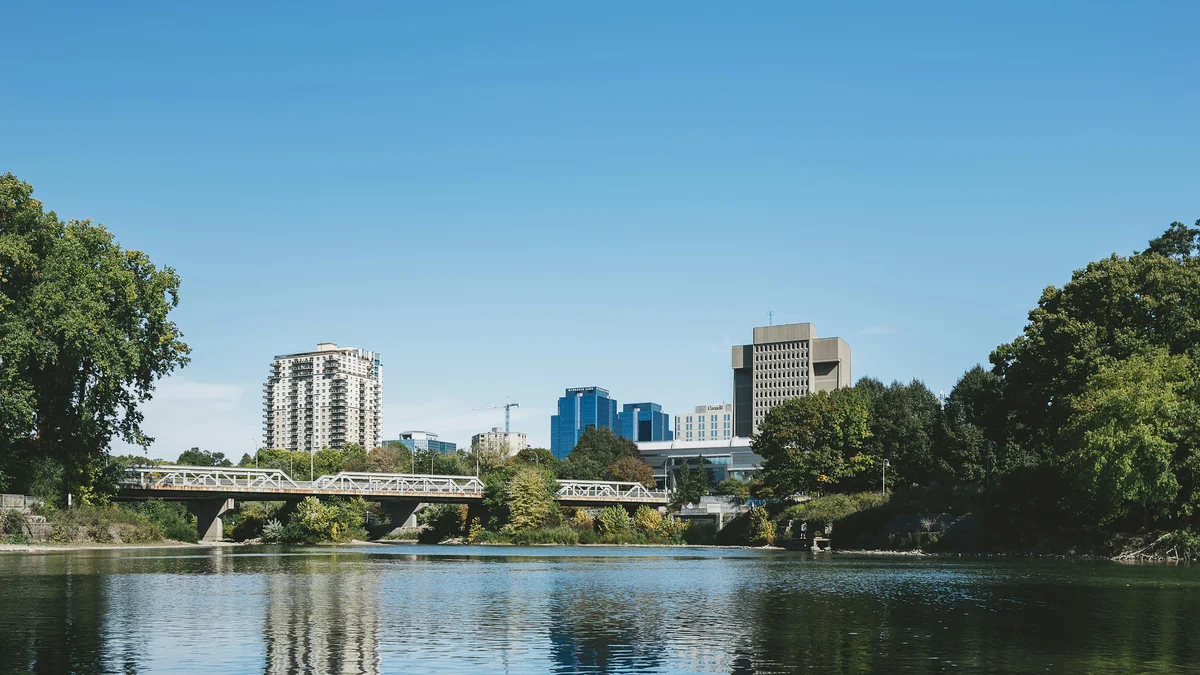
An art and history museum overlooking the forks of the Thames River, with a permanent collection focused on Canadian and regional art alongside changing exhibitions on the city's history.
Visitor guide
Museum London is an art and history museum at the forks of the Thames River (Deshkan Ziibi) in downtown London, Ontario. It cares for a collection of well over 5,000 artworks and close to 50,000 artifacts, and it is an independent, not-for-profit registered charity.
The museum's own account says it began as the London Regional Art Gallery in 1940, operating from the London Public Library. Other accounts name it the Elsie Perrin Williams Memorial Art Gallery and Museum, after the heiress whose bequest paid for the library building in which it was housed; she died in 1934, and the library opened in October 1940. The museum moved to a purpose-built home on Ridout Street in 1980 and took the name Museum London in 2001 to reflect its combined art and history focus. The City of London's history collections were brought under the same roof in 1989. Because sources describe these steps differently, we describe the lineage rather than a single founding date.
The building was designed by the Canadian architect Raymond Moriyama, working with Teshima, and opened in May 1980. Docomomo Ontario notes that the design was influenced by Louis Kahn's Kimbell Art Museum in Fort Worth, which shows in the parallel rows of concrete barrel vaults lit from above by linear skylights. A barrel-vaulted porte-cochere on the east side forms the main entrance, and the metal cladding was originally blue, with stainless-steel sunscreens. Moriyama's other well-known works include Science North in Sudbury and the Bata Shoe Museum in Toronto. The museum occupies its own block between two National Historic Sites of Canada, the Middlesex County Courthouse and the Ridout Street Complex, and lies within London's Downtown Heritage Conservation District. A National Historic Sites and Monuments Board plaque on the site commemorates the painter Paul Peel (1860-1892), whose work is in the collection.
The museum states that its collection includes over 5,600 artworks, both historical and contemporary, spanning painting, sculpture, photography, digital media and installation. Wikipedia lists works by Lawren Harris, Kent Monkman and Edward Burtynsky in the collection. Museum records also include a 1960 painting by A. J. Casson, a member of the Group of Seven, given in 1978, and a studio desk used by Greg Curnoe, a leading figure of the London Regionalism movement, donated by his family in 2006. The museum also cares for nearly 50,000 artifacts, including everyday objects that reflect London's evolving identity. In 2004 the London Health Sciences Centre gave the museum its medical artifact collection, according to Wikipedia. What is on view changes with the exhibition schedule, so check the museum before you go for current shows. Museum London describes Paul Peel as London's best-known nineteenth-century artist, and the museum has mounted exhibitions surveying local art, including a 2017 show on 150 years of art-making in London.
Museum London acknowledges that it sits at the forks of the Deshkan Ziibi on the traditional lands of the Anishinaabek, Haudenosaunee, Lunaapeewak and Attawandaron peoples, and within the homeland of the Chippewas of the Thames, Oneida Nation and Munsee Delaware Nation.
See every tour and attraction we cover in London, Ontario.