TorontoOntario · 36 tours
 Niagara FallsOntario · 25 tours
 New York CityNew York · 30 tours
 Las VegasNevada · 8 tours
 San FranciscoCalifornia · 16 tours
 VancouverBritish Columbia · 17 tours
 DubaiUAE · 54 tours
 Abu DhabiUAE · 5 tours
 Buenos AiresArgentina · 23 tours
 AthensGreece · 31 tours
 AucklandNew Zealand · 38 tours
 CancunMexico · 54 tours
No destinations match “”. Try searching all tours instead — that search understands full questions, not just place names.
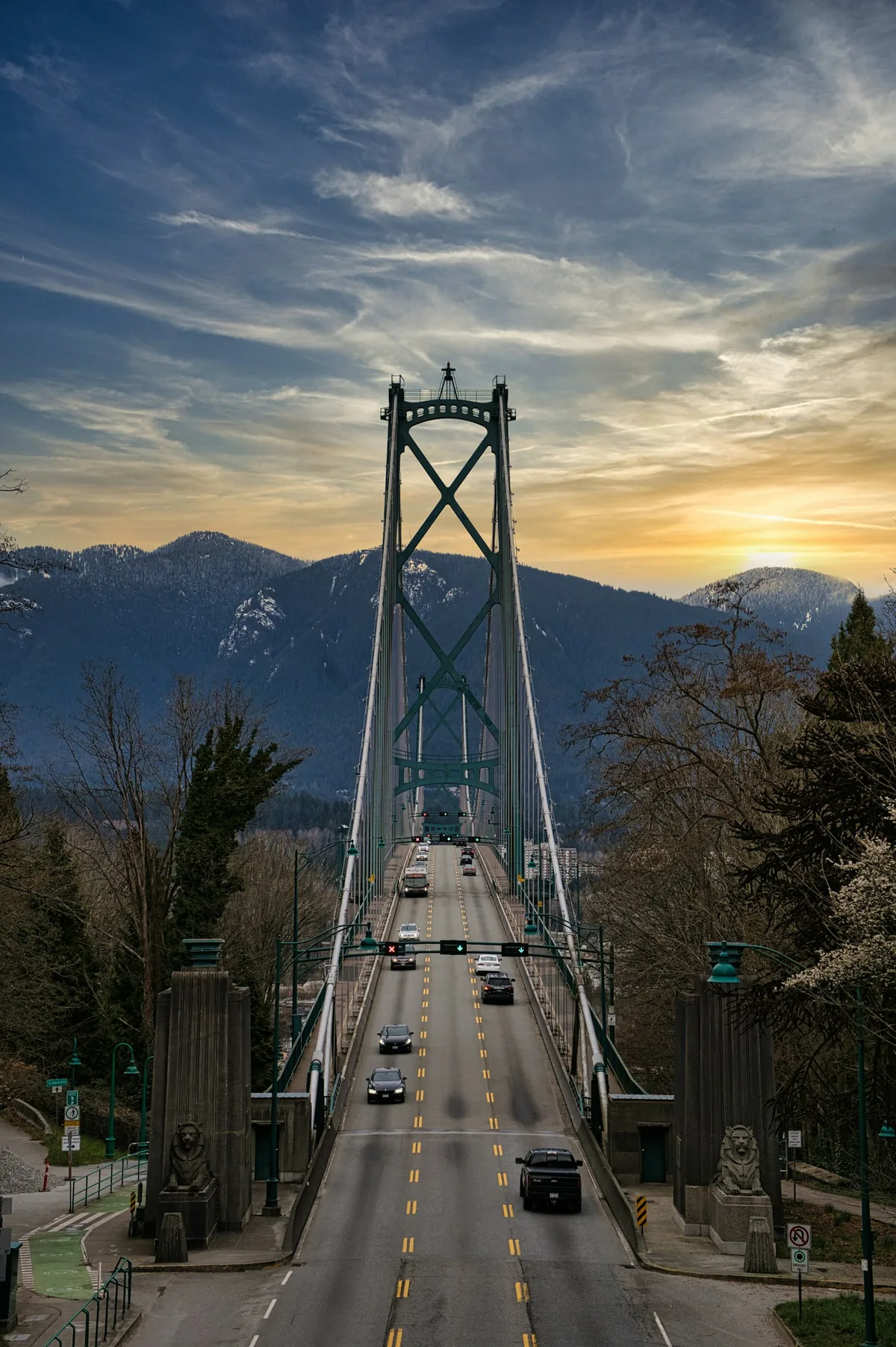
A steel suspension bridge linking downtown Vancouver to the North Shore, with the Coast Mountains as a backdrop.
Visitor guide
The Lions Gate Bridge, officially the First Narrows Bridge, is a suspension bridge carrying Highways 99 and 1A across the entrance to Burrard Inlet. It links Stanley Park and Vancouver to the North Shore communities of West Vancouver and North Vancouver, and it is a National Historic Site of Canada. Its name comes from The Lions, the twin peaks visible in the mountains to the north.
A bridge across the First Narrows was proposed as early as 1890 by land speculator George Grant Mackay. A 1927 plebiscite failed, but a 1933 plebiscite passed with roughly 70% support. The bridge was financed by the Guinness brewing family through a development syndicate, partly to open the British Properties lands they owned in West Vancouver, and engineer Alfred J.T. Taylor is credited with persuading them to proceed. Wikipedia notes that the 1933 bylaw included a discriminatory clause barring Asian workers, a stain on the project's history.
The Montreal firm Monsarrat and Pratley designed the bridge, and construction began on March 31, 1937, at a reported cost of $5,873,837. It opened to traffic on November 14, 1938, with King George VI and Queen Elizabeth presiding over the official opening in 1939. The Guinness interests charged tolls until April 1, 1963, and the Province of British Columbia purchased the bridge in 1955 for its original construction cost.
Parks Canada's register says the bridge was formally recognised as a National Historic Site on December 10, 2004; Wikipedia gives March 24, 2005, so sources differ on the date. The register cites four reasons: it is an outstanding landmark, its elegant design complements a striking setting, it was an outstanding engineering achievement, and it opened the North Shore suburbs to growth. When built, it was the longest suspension bridge in the British Empire.
The bridge's reported dimensions are a total length of about 1,823 metres (5,981 feet), a main span of 473 metres, towers about 111 metres tall and 61 metres of clearance for ships. The Parks Canada register describes the bridge as 1,517 metres including approach spans, which is a different way of measuring, so figures vary by source.
Several changes have kept it in service. A reversible centre lane was added in 1952, and in 1975 the original concrete deck was replaced with a steel orthotropic deck. Decorative lights, a gift from the Guinness family, were installed in 1986, and a counterflow system followed in 1994. From 2000 to 2001 the suspended structure was replaced section by section while traffic continued to run, which Parks Canada highlights as a notable feat. Wikipedia reports that the lighting was converted to LEDs in 2009.
The south entrance, where the bridge emerges from Stanley Park, features two Art Deco concrete lion sculptures by Charles Marega, which Parks Canada lists as character-defining elements, along with the twin tapered steel towers and the bridge's decorative night lighting. Pedestrian and cyclist sidewalks run along both sides.
A private driver can build the crossing into a route from downtown through Stanley Park to the North Shore, so the whole group enjoys the view and the Lions peaks without anyone managing the traffic.
See every tour and attraction we cover in Vancouver.