TorontoOntario · 36 tours
 Niagara FallsOntario · 25 tours
 New York CityNew York · 30 tours
 Las VegasNevada · 8 tours
 San FranciscoCalifornia · 16 tours
 VancouverBritish Columbia · 17 tours
 DubaiUAE · 54 tours
 Abu DhabiUAE · 5 tours
 Buenos AiresArgentina · 23 tours
 AthensGreece · 31 tours
 AucklandNew Zealand · 38 tours
 CancunMexico · 54 tours
No destinations match “”. Try searching all tours instead — that search understands full questions, not just place names.
A wetland national park within Jūrmala, centered on the former Soviet-era sulfur-spa town of Ķemeri, known for its biodiversity and a boardwalk trail across the Great Ķemeri Bog to a viewing tower.
 Multi-Day Tours
A 10-day, in-depth loop from Riga through Gauja National Park, the medieval town of Cēsis, Rundāle Palace, Kuldīga, Liepāja, the resort town of Jūrmala, and the bogs and former spa town of Ķemeri National Park.
 Multi-Day Tours
A 13-day adventure across Latvia and Lithuania — hiking, biking, and kayaking through Gauja and Ķemeri National Parks, the Curonian Spit's sand dunes, Kuldīga and Liepāja, and the medieval castles of Trakai and Vilnius.
Visitor guide
Kemeri National Park is a wetland and forest national park in western Latvia, lying just west of Jurmala. Established in 1997, it is classified as an IUCN Category II national park and is known for the Great Kemeri Bog and its mineral and sulphur springs.
Wikipedia describes Kemeri as the third largest national park in Latvia, though its figure for the area varies between about 362 and 382 square kilometres within the same article. Forests cover about 57 percent of the park, bogs about 24 percent, meadows about 6 percent and water, including lakes, rivers, sulphur springs and sea, about 10 percent. Several lakes are former lagoons of the Littorina Sea, and Lake Kanieris is a Ramsar wetland site.
Bog formation began roughly 10,000 years ago, after the glacial period, as the climate warmed and became wetter, and sapropelic mud accumulated on lake bottoms. Many streams were drained for agriculture but still support rare native snails and mussels, storks and otters.
The Great Kemeri Bog, or Lielais Kemeru tirelis, is an internationally important wetland and the park's most significant mire. Fens, transition bogs and raised bogs are all present. Two boardwalks cross it, a short one of 1.4 kilometres and a long one of 3.4 kilometres with an observation platform, and the long route is popular with photographers at sunrise and sunset.
The low nutrient and oxygen levels favour specialised plants such as cottongrass, heather, bog rosemary and sundews, along with sphagnum moss and Scots pine. Mosses and orchids are especially abundant, and wild berries include cranberries, cloudberries and blueberries. Birds include the common crane, wood sandpiper and European golden plover, and the latter two breed only in raised bog habitat. Wikipedia also notes that numerous World War II tanks were swallowed by the bog.
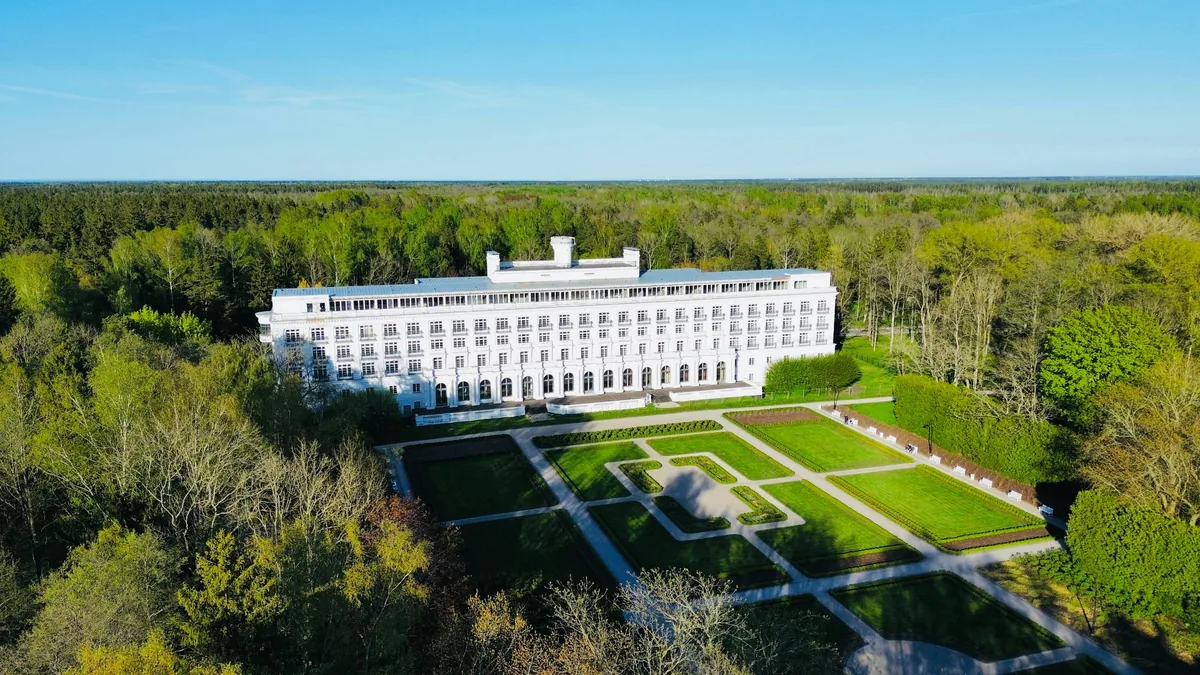
Gypsum in the subsurface and sulphate-reducing bacteria produce hydrogen sulphide gas, which dissolves into the springs. The mineral waters and muds are used in health resorts in the nearby town of Kemeri to treat digestive and skin conditions, and the springs led to resorts, spas and sanatoriums being developed in the 19th century. In neighbouring Jurmala, the Kemeri hotel-sanatorium, designed by Eizens Laube and opened in 1936, is considered a prominent example of Latvian neo-classical architecture.
The spa town of Kemeri, now a district of Jurmala, was a separate town from 1928 to 1959. Its mineral springs were recognised as having curative properties in 1796, and the first chemical analysis of the water followed in 1818. In 1838 Tsar Nicholas I gave land for the first mineral-water bath-house, and the resort was founded as Bad Kemmern; the railway station opened in 1877. A mud bath facility was built in 1924, and a 42-metre water tower with a viewing platform followed in 1929. The Kemeri resort park underwent reconstruction between 2019 and 2021.
Visits here are typically centred on the boardwalk trails, which allow walking through fragile bog habitat without leaving the path. A private guided tour with a driver suits the park well, as it lies a short drive from Riga and Jurmala.
See every tour and attraction we cover in Latvia.