TorontoOntario · 36 tours
 Niagara FallsOntario · 25 tours
 New York CityNew York · 30 tours
 Las VegasNevada · 8 tours
 San FranciscoCalifornia · 16 tours
 VancouverBritish Columbia · 17 tours
 DubaiUAE · 54 tours
 Abu DhabiUAE · 5 tours
 Buenos AiresArgentina · 23 tours
 AthensGreece · 31 tours
 AucklandNew Zealand · 38 tours
 CancunMexico · 54 tours
No destinations match “”. Try searching all tours instead — that search understands full questions, not just place names.
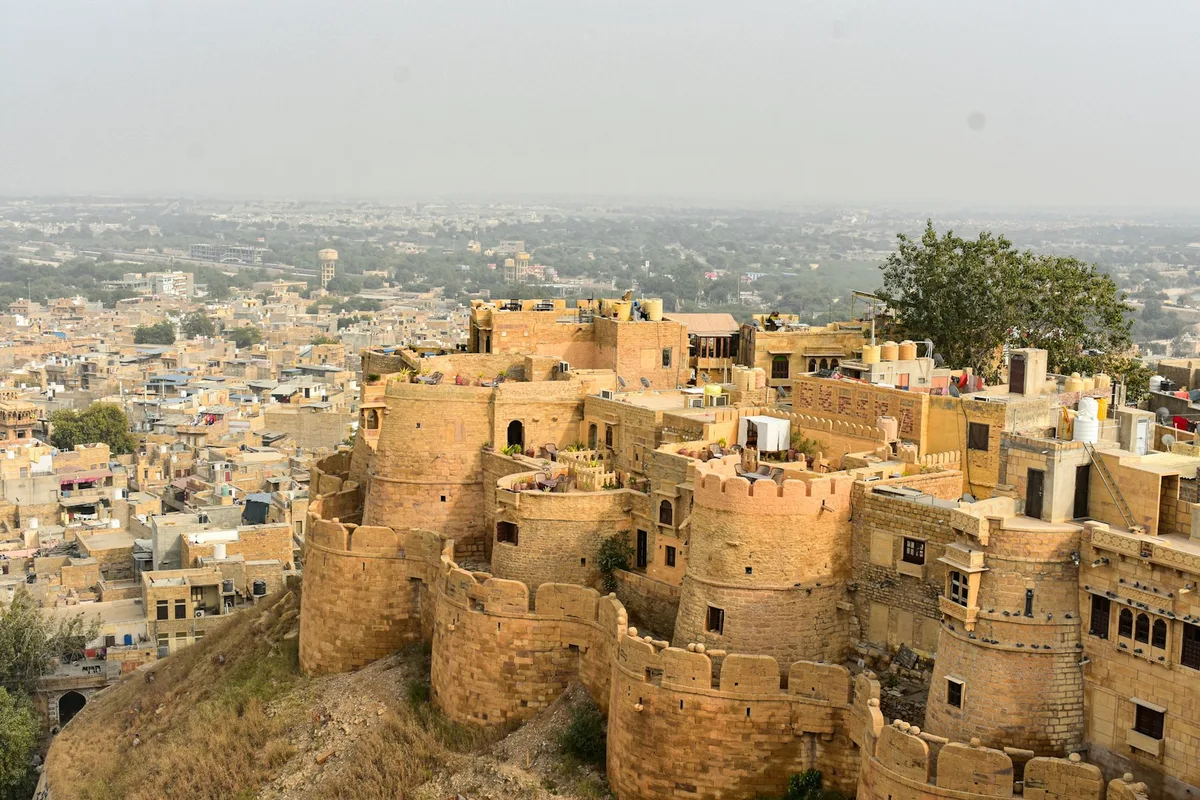
A living sandstone fort rising out of the Thar Desert, still home to thousands of residents inside its walls, one of the few fortified 'living forts' left in the world.
Visitor guide
Jaisalmer Fort is a yellow sandstone fortress on Trikuta Hill in the Thar Desert, in the city of Jaisalmer, Rajasthan, India. It is one of the few living forts in the world, because a substantial residential community still lives inside its walls. In 2013 it was inscribed by UNESCO, together with five other Rajasthan forts, as part of the Hill Forts of Rajasthan.
According to Wikipedia, tradition says the fort was built in 1156 CE by Rawal Jaisal, a Bhati Rajput, who founded the city of Jaisalmer and gave it his name after being dissatisfied with an earlier capital at Lodhruva. The fort stood at the crossroads of important trade routes, including branches of the old Silk Road, which helped Jaisalmer grow wealthy. Its walls are the colour of a lion by day and turn honey-gold at sunset, which camouflages them against the surrounding desert. For this reason it is also called Sonar Quila, the Golden Fort. The name Sonar Kella became widely known through the Satyajit Ray film of that title, which was shot at the fort.
The fort has had a turbulent past. Wikipedia mentions a long siege by Alauddin Khalji of the Delhi Sultanate around 1299, a later attack in the 1500s, and a period of Mughal control that ended in 1762. In 1818 the ruler signed a treaty with the East India Company that allowed him to keep control of the fort. As sea trade through Bombay grew under British rule, Jaisalmer's caravan trade declined, and the closure of the old trade routes after Partition ended its role in international commerce.
The fort is about 460 metres long and 230 metres wide and stands on a hill rising roughly 76 metres above the surrounding land. Its defences include a three-ring layout, an outer wall about 4.6 metres high and an inner perimeter of about 4 kilometres. The fort has 99 bastions, of which 92 were built or substantially rebuilt between 1633 and 1647, according to Wikipedia. Visitors pass through four massive gateways along the approach.
Inside are the Raj Mahal Palace, the former residence of the Maharawal, and Jain temples built of yellow sandstone between the 12th and 16th centuries, including one dedicated to Sambhavanatha that is said to hold more than 600 idols. Wikipedia also lists the Laxminath temple, dedicated to Lakshmi and Vishnu, and a 450-year-old haveli once home to Brahmin priests that now houses a museum.
At one time the whole city lived within the fort. Today about 4,000 people, many descended from Brahmin and Rajput families who once served the Bhati rulers, still reside inside. Many people have moved to the foot of the hill over time. The fort contains guesthouses, shops and eateries, which gives it the feel of a working neighbourhood rather than a museum. The carved sandstone havelis in the town below, such as Nathmal Haveli, Patwon Ki Haveli and the Vyas haveli, reflect the wealth of the former trading city.
Wikipedia notes that the fort faces conservation challenges, including water seepage, ageing buildings and the weak sedimentary rock of the hill. Parts of the walls and the Rani Ka Mahal have collapsed over the years. The World Monuments Fund placed the fort on its watch lists in 1996, 1998 and 2000 because of pressure from residents and visitors. A traditional drainage system, the ghut nali, was designed to carry rainwater away in four directions, though later construction has reduced its effectiveness.
The fort is best seen on foot through its narrow lanes, and a private tour with a driver and local guide helps with context on the gates, temples and havelis. Sunset is a popular time to see the walls glow, and the fort is often combined with desert experiences around Jaisalmer.
See every tour and attraction we cover in India.