TorontoOntario · 36 tours
 Niagara FallsOntario · 25 tours
 New York CityNew York · 30 tours
 Las VegasNevada · 8 tours
 San FranciscoCalifornia · 16 tours
 VancouverBritish Columbia · 17 tours
 DubaiUAE · 54 tours
 Abu DhabiUAE · 5 tours
 Buenos AiresArgentina · 23 tours
 AthensGreece · 31 tours
 AucklandNew Zealand · 38 tours
 CancunMexico · 54 tours
No destinations match “”. Try searching all tours instead — that search understands full questions, not just place names.
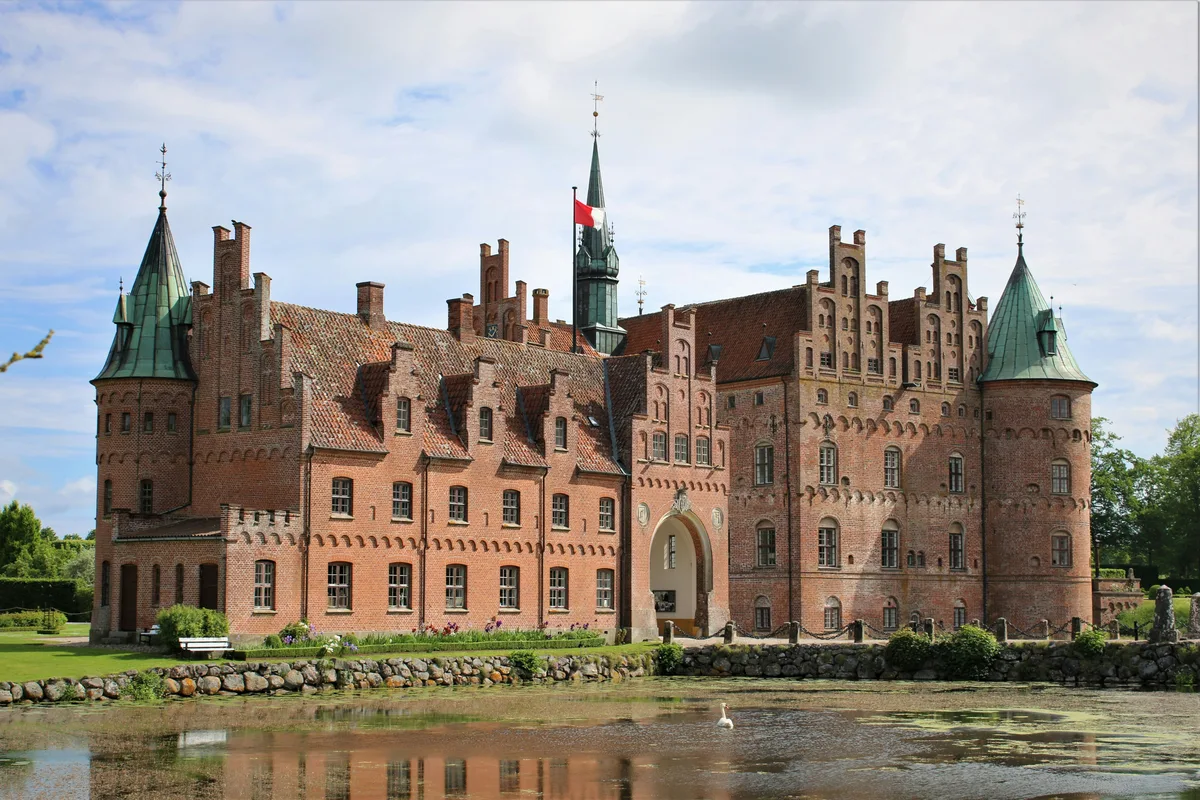
One of Europe's best-preserved Renaissance water castles, built on oak piles in the middle of a lake on the island of Funen, with twin conical-roofed towers and formal gardens around the moat.
Visitor guide
Egeskov Castle is a water castle near Kvaerndrup in the south of the island of Funen, Denmark. Wikipedia describes it as Denmark's best-preserved Renaissance water castle, standing on oak piles in a small lake and surrounded by a large park.
The estate is first mentioned in 1405, and the present castle was erected in 1554 by Frands Brockenhuus. It was built during turbulent times, including the civil war known as the Count's Feud and the upheaval of the Reformation, when many Danish noblemen built their homes as fortifications. The castle stands on oak piles in a small lake with a maximum depth of about five metres, and originally the only access was by a drawbridge. According to legend, an entire forest of oak trees was needed for the foundation, which is why the name Egeskov means oak forest. The Bille-Brahe family acquired the estate in 1784 and it passed in 1882 to the counts Ahlefeldt-Laurvig-Bille, whose family still owns it.
The exterior is late Gothic, while the interiors show early Renaissance design. The castle consists of two long buildings joined by a thick double wall, which allowed defenders to withdraw from one building and keep fighting from the other. The wall is over a metre thick and contains secret staircases and a well. Two round corner towers allowed defenders to attack an enemy's flanks, and other defences include artillery ports, scalding holes and arrow slits. The structure also includes early indoor plumbing with vertical shafts, which Wikipedia calls among the first of its kind in Europe. Inside, a great hall holds a large painting of Niels Juel, who defeated the Swedish fleet at the Battle of Koge Bay in 1677. The bricks are an oversized medieval type sometimes called monks' bricks, and several large rooms have massive exposed beams. A heavy iron chest dating from at least the 16th century came from Hvedholm Castle, a property once owned by the Egeskov estate.
The park surrounding the castle covers 20 hectares and is divided into several gardens, including a Renaissance garden with fountains and topiary, an English garden, a water garden, an herb garden and a peasant's garden. Egeskov's own site describes the fuchsia garden as one of Europe's most extensive fuchsia collections, holding around 450 varieties; other sources cite 104 species. There are four hedge mazes, the oldest a beech maze that is several hundred years old, and the newest a bamboo maze with a Chinese tower at its centre. A three-metre sundial in the park was designed by the Danish poet and mathematician Piet Hein.
The estate houses several museums, including collections of vintage cars and motorcycles, an agricultural history collection in a thatched half-timbered building, flying vehicles including airplanes and helicopters, and vehicles from the Danish rescue company Falck. In 1986 a full-sized replica of the castle was built in Hokkaido, Japan, to house an aquarium.
Funen is a rural island, so a private guided visit with a driver is a convenient way to combine Egeskov with other Funen sights.
See every tour and attraction we cover in Denmark.